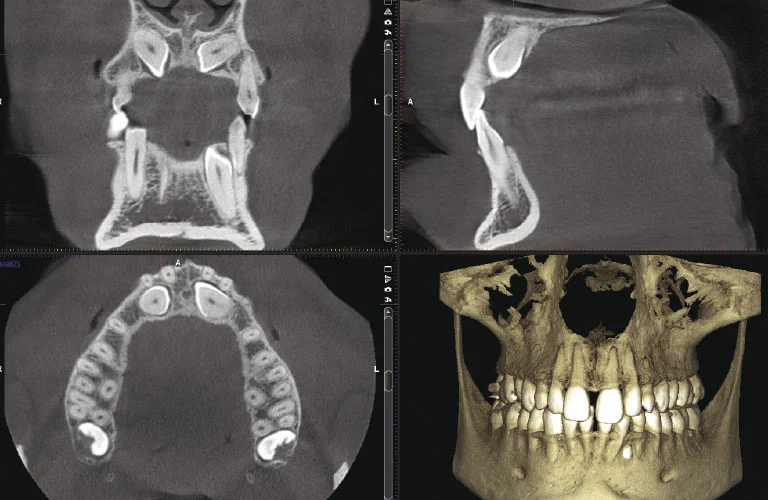
3D cone beam computed tomography (CBCT) is an imaging technology that allows dentists to evaluate the underlying bone structure, as well as the nerve pathways and surrounding soft tissues. The CBCT systems used by dental professionals rotate around the patient, capturing data using a cone-shaped X-ray beam. These data are used to reconstruct a three-dimensional (3D) image of the following regions of the patient’s anatomy: dental (teeth); oral and maxillofacial region (mouth, jaw, and neck); and ears, nose, and throat. Dental CBCT images provide three-dimensional (3-D) information, rather than the two-dimensional (2-D) information provided by a panoramic X-ray image. This may help with the diagnosis, treatment planning and evaluation of certain conditions.
We recommend a CBCT scan if you are considering dental implants because it can provide a detailed picture of your bones, nerves, and soft tissues. A single CBCT scan can show potential dental issues such as tooth decay, bone loss, abnormal growths, facial fractures, periodontal infections, irregularities of the temporomandibular joint, and problems with the tooth roots or dental pulp. This allows your implant dentist to determine if dental implants can be safely and effectively placed.